
The Best Writing Software Isn’t What You Think

Jason Kolinsky

I’ve spent a lot of time around writers.
Screenwriters. Novelists. First-time storytellers trying to figure it out. Experienced ones still trying to get better.
And no matter where they are in the process, the goal is usually the same:
They’re not just trying to write more.
They’re trying to become better storytellers.
The kind who knows when a moment matters.
Who knows how a scene is meant to be felt.
Who can land an ending—or understand why it doesn’t.
That’s the real craft at work.
Writing Software for Screenwriters and Novelists
Writers looking for screenwriting software, novel writing software, or writing software for authors usually end up in the same place: comparing tools like Final Draft, Scrivener, and others.
Each one solves a different part of the process.
Other Writing Tools Writers Tend to Gravitate Toward
Over time, you also start to notice something else.
Writers don’t all use the same tools.
They gravitate toward whatever fits how they like to work.
Some lean toward tools like Celtx or WriterDuet—especially when they’re writing scripts and want something collaborative or flexible.
Others prefer something like Ulysses or similar apps for long-form writing—clean, minimal spaces where they can focus on the words.
And then there are writers who move between a few different tools, depending on where they are in the process.
At some point, the search begins.
Not for answers exactly… but for something that helps.
So you try a few tools.
Because it feels like the next step.
And to be clear, these tools are good at what they’re built to do.
They’ve earned their place.
Final Draft (Screenwriting Software)
Final Draft has become the industry standard for screenplay formatting.
It gets scripts into a form that professionals expect—clean, consistent, and ready to be shared. When a script is moving toward production, that level of consistency matters.
Scrivener (Novel Writing Software)
Scrivener is used for working on long-form writing projects.
Writers use it to break a story into chapters, keep track of notes, store research, and move sections around as the draft evolves.
Tools like Scrivener help writers manage content: chapters, notes, and drafts.
Save the Cat!® Story Suite (Screenwriting & Novel Writing Software)
Save the Cat! Story Suite is story structure software that works like a Digital Writer’s Board, giving you a clear view of your story so you can move things around and see what’s working.
Over Time, I Started Noticing Something
Writers weren’t getting stuck because they chose the wrong tool.
They were getting stuck because something deeper in the story wasn’t working.
It usually shows up the same way.
The middle starts to drift.
The stakes don’t quite escalate.
You get to the ending… and it doesn’t land the way you hoped.
And the hardest part is, you don’t always know why.
So you keep writing.
Or you start over.
Or you switch tools again, hoping something clicks.
But this part of the process, the part where you’re trying to understand what your story is actually doing… most tools don’t touch it.
Not the pages.
Not the folders.
The function.
What is this scene doing?
Why does this moment matter?
Is anything really changing?
How Structure Helps
That’s where structure comes in.
Not as a formula.
Not as something rigid.
Just a way to see the story more clearly.
To track movement:
- when something shifts
- when something escalates
- when something lands
Save the Cat! Story Suite was built around that part of the process. The part before things get locked in. It gives writers a way to look at their story through the lens of structure, using virtual scene cards in the Save the Cat! Beat Sheet and Digital Writer’s Board to map out key moments, track pacing, and understand how a story moves from beginning to end.
It also brings in genre, not just as a label, but as a way of understanding both the kind of story you’re telling and what the audience is expecting from it.
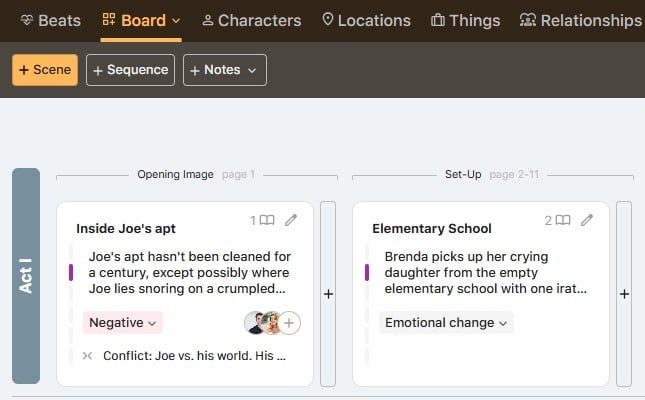
The first 2 scene cards on a Save the Cat! Story Suite Digital Writer’s Board
At that level, the work becomes clearer.
You’re not just writing scenes. You’re seeing:
- where the story turns
- where the stakes shift
- where the emotional change happens
So when you go back to the page… you have guidance to lean on.
The Question I Get the Most
How does Save the Cat! Story Suite fit with the tools I’m already using?
Most writers don’t use just one tool. They move between them, depending on what they’re working on.
Save the Cat! Story Suite tends to work best…
When you’re still figuring things out.
When the structure isn’t locked.
When you’re trying to see the story clearly.
When you’re tightening and putting the pieces together.
Because something changes when the structure is clear.
Characters stop wandering.
Scenes have purpose.
Moments start to connect.
The story begins to carry itself.
How Writers Use Final Draft, Scrivener, and Save the Cat! Story Suite
Tool | Primary Use |
| Final Draft | Screenplay formatting |
| Scrivener | Manuscript content management |
| Save the Cat! Story Suite | Story structure and character transformation |
The writers I’ve seen make the biggest leap aren’t the ones who find better tools.
They’re the ones who learn how to use the right tools at the right time and, more importantly, how to see their story clearly before they commit it to the page.
And once that happens…
Everything else tends to fall into place.
Other Questions I’m Asked About Writing Software
What is writing software used for?
Writing software helps with different parts of the process. Some tools focus on formatting, others on working through drafts, and some help with shaping the story itself.
Do I need more than one writing tool?
Most writers end up using more than one, depending on where they are in the process—one tool for shaping the story, another for writing, and another for formatting.
Where does story structure fit into the writing process?
Structure can fit into any writer’s process.
It often comes in earlier than most writers expect; before a draft is fully formed, structure helps you see how the story is working and where it needs adjustment.
And for writers who prefer to draft first, structure becomes a way to review and tighten the story, making sure each moment serves a purpose and the story is working as hard as it can.
How do different writing tools fit together?
Most writers move between tools depending on what they’re working on—shaping the story first, then writing, then formatting. Each tool supports a different stage.
Check out the Save the Cat! Story Suite video: How to Get Started>>
Check out the Save the Cat! Story Suite video: How to Create and Manage Characters>>
Share this article:






Similar Articles





Subscribe to Save the Cat! Newsletter