
From Save the Cat!® Beat Sheet to Save the Cat!® Story Suite

Jason Kolinsky
How the Save the Cat! method evolved into story-planning software for screenwriters and novelists
When Blake Snyder first put the Save the Cat! beat sheet on paper, he wasn’t thinking about software. After studying hundreds of movies, Blake was trying to solve something simpler.
How does a writer create a story that makes sense?
Not in theory. Not academically.
Practically.
A way writers could actually use.
To look at a story and understand its shape, its purpose, its characters.
That was the starting point.
For a long time, 15 beats were enough.
All a writer needed were index cards and a wall.
Just step back and see your story.
Where it turned. Where it slowed down. Where something wasn’t working.
That process—the story board—became part of how people used Save the Cat!
It wasn’t just about structure anymore.
It was about seeing the story clearly.
As more writers started working this way, something else became obvious. Structure alone wasn’t the whole picture.
Two stories could follow the same beats and feel completely different.
That’s where genre came in.
Not genre as in comedy or drama.
But genre as story type.
Monster in the House. Golden Fleece. Fool Triumphant.
Each one carries a different expectation. A different rhythm. A different kind of ending.
Now it wasn’t just:
“Where does this moment go?”
It became:
“Why does this moment matter?”
When we started building Save the Cat! story-planning software, that was really the challenge.
How do you take all of this:
- the beat sheet
- the board
- the way characters move through a story
- the role of genre
and make it something writers can actually work inside?
Not something that replaces the process.
Something that reflects it.
The early versions focused on structure.
Getting the beats onto a board. Letting writers move scenes around. Start shaping a story digitally.
And that worked.
But over time, we saw how writers were really using the software.
They weren’t just outlining.
They were trying to figure out:
- if the story worked
- if the characters were changing
- if the emotional movement was there
- if the story was delivering on its genre
That’s a different problem.
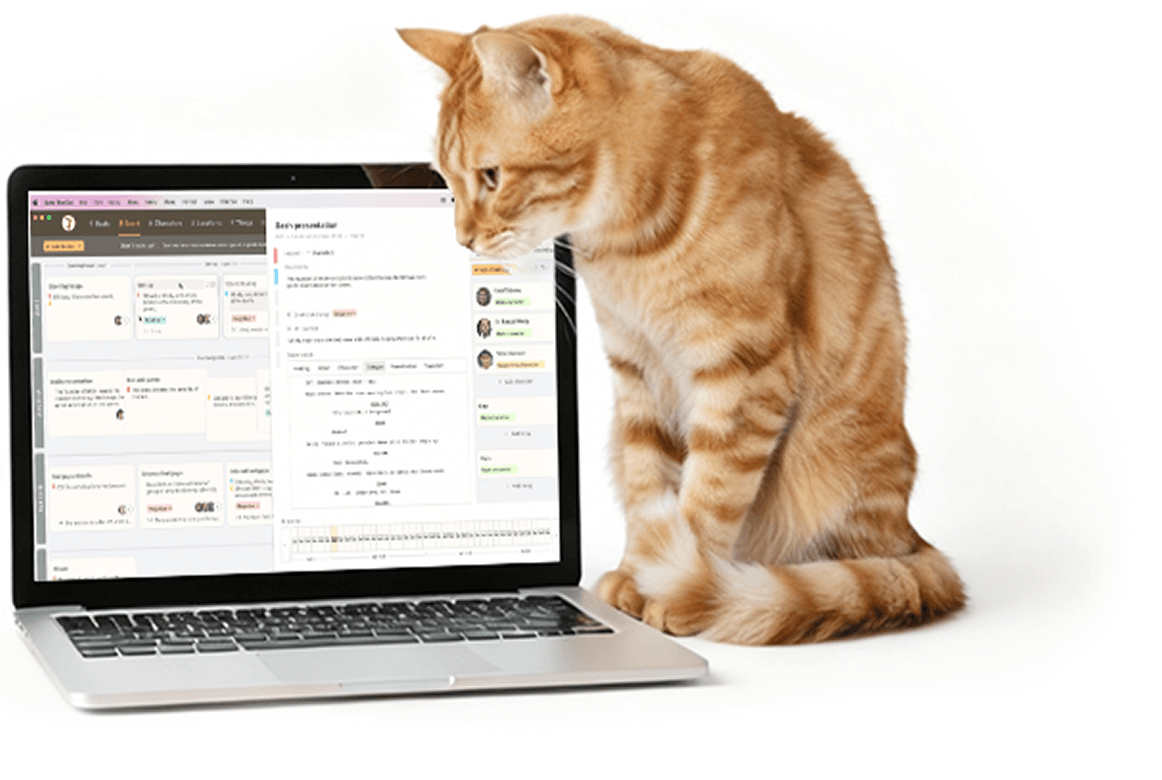
So Story Suite became less about structure alone—and more about bringing the full process together.
Now when you open a project, you’re not jumping between tools.
You’re working in one place where:
- the beat sheet maps the structure
- the board lets you see the story
- your characters connect across scenes
- and your story type keeps everything aligned.
It’s all part of the same system: How to Get Started with the Save the Cat! Story Suite
The goal isn’t to organize your writing.
It’s to help you understand your story.
We’ve made it easy to build and manage your characters inside that system.
Not as separate notes.
Not as isolated profiles.
But as part of the story itself.
Where:
- relationships connect
- appearances are tracked
- arcs become visible
So instead of asking:
“Who is this character?”
You can start asking:
“What are they doing in the story?”
If you want to see how that works in practice, we walk through it here: How to Create and Manage Characters with Save the Cat! Story Suite
What Blake started was simple.
A way to break a story down so you could understand it.
Save the Cat!® Story Suite carries that forward.
From beat sheet…
to board…
to genre…
to a working story…
in a formatted script or manuscript.
All in one place.
Stuck with your story?
Save the Cat!® Story Suite software brings the method and your story work into one clear, organized workspace.

Share this article:






Similar Articles






Subscribe to Save the Cat! Newsletter