
Home › Tips and Tactics › A Writer’s Guide to Beats and Beat Sheets
A Writer’s Guide to Beats and Beat Sheets

Jamie Nash

Okay, I’m going to tackle a hard question. The hardest:
What exactly is a ‘beat’?
I’ve written three books about the Save the Cat!® beat sheet, taught classes, written hundreds of beat sheets, and here’s the way I usually answer:
A “beat” is a significant story moment that changes the direction of the plot, reveals new information, or shifts the emotional stakes. Beats are the building blocks of scenes, sequences, and entire movies and novels—and understanding them is essential for writing a compelling screenplay.
When identifying beats, you’re focusing on how these moments propel the story forward, without getting bogged down by the execution details (like dialogue, jokes, or intricate action).
A beat isn’t necessarily an entire scene; it can just be a key shift within a scene. For example, a character might make an important decision, learn new information, or face a change in the stakes.
Let’s say we’re in a heist movie, and the team is about to steal a priceless diamond:
Scene: The team sneaks into the museum.
Beat 1: One of them accidentally trips the laser alarm (oops!).
Beat 2: The guards are alerted, raising the tension.
Beat 3: The team scrambles to shut down the alarm and complete the heist.
Each of these beats is a key moment where something shifts. The tension escalates, the stakes rise, and the story moves forward.
Beats in Screenwriting
Now, let’s take a beat (pun intended) to talk about another use of the word “beat.” In screenplays, a “beat” is kind of a magic word used to indicate a dramatic pause—usually before something significant happens, like a character making an important decision or delivering a powerful line of dialogue.
For example:
JOHNNY SIXGUNS
I can’t do it.
Beat.
They drop the gun.
Or sometimes in dialogue:
JOHNNY SIXGUNS
I can’t do it.
(beat)
I love you.
Here, “beat” signals a moment of tension or realization. It tells the actor to pause, letting the emotional weight of the moment sink in before continuing the action or dialogue. In this context, it’s more about pacing than moving the plot forward.
Beat vs. Scene
A beat is not the same as a scene. A single scene can contain multiple beats, while a high-level beat can span several scenes.
Let’s break down a scene with multiple beats:
Scene: A kid sneaks into the kitchen to steal cookies from the jar.
Beat 1: He tiptoes in, making sure no one’s watching.
Beat 2: He reaches for the jar but knocks it over (uh-oh!).
Beat 3: He catches the jar just before it falls (phew!).
Beat 4: The lid flies off, and cookies scatter everywhere (disaster!).
Each beat changes the direction of the scene. What starts as a sneaky mission quickly turns into a potential disaster, raising the stakes—all within one scene.
High-Level Beats
If we were outlining a Superhero movie or novel, we might break it down into high-level beats like this:
- A boy is bitten by a radioactive stink bug.
- He begins to develop stink bug powers.
- He decides to use his powers to make money.
- He lets a criminal go, and the criminal kills his uncle.
- He decides to use his powers to find his uncle’s killer.
This is a series of high-level beats, each pushing the story forward. Each beat might consist of multiple scenes and could be further broken down into smaller beats. How detailed you get with your beats depends on what stage of the process you’re in. When first outlining a story, it’s helpful to stick to high-level beats and save the smaller, scene-level beats for later.
Blake Snyder and the Beat Sheet
Blake Snyder’s famous Save the Cat! beat sheet breaks stories into 15 essential beats that guide the emotional and structural arc of a screenplay. Each beat has a specific purpose, from introducing the hero to delivering a satisfying conclusion. These beats give your story structure and guide its emotional arc.
Remember: a beat = moment. A beat sheet = outline of beats.
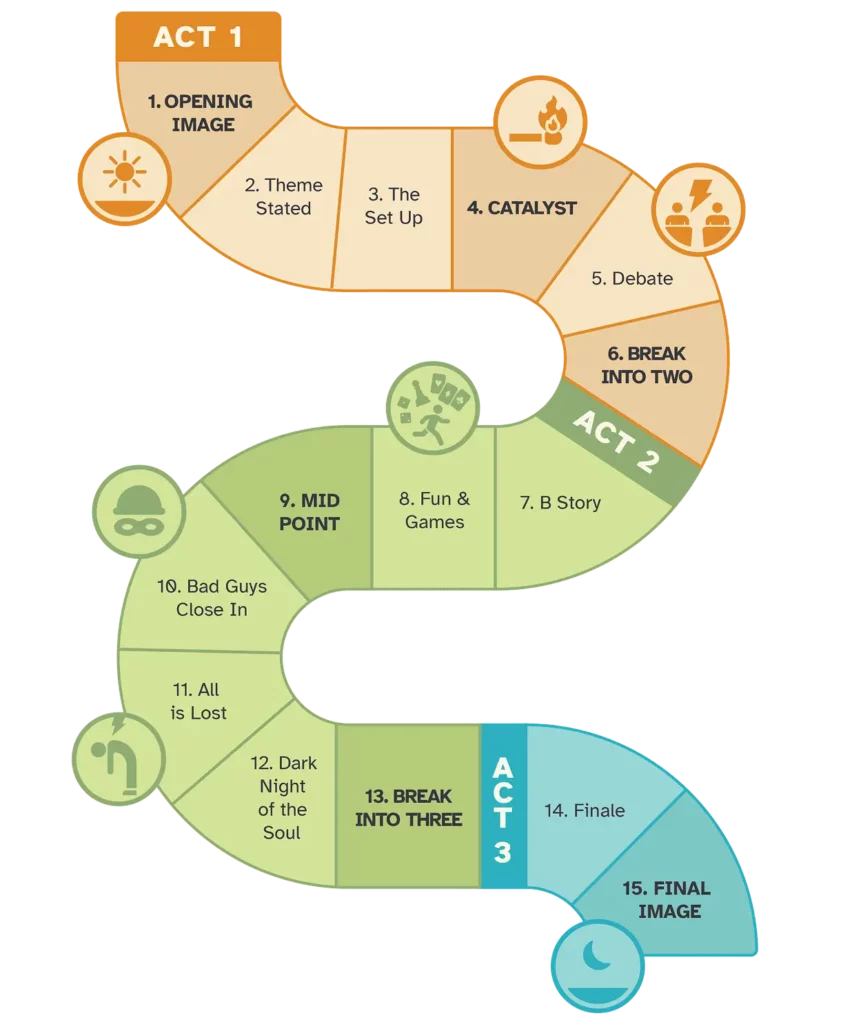
While the Save the Cat! method highlights 15 beats, there are actually more. The 15 are just the most critical ones, but within those, there are often additional beats. For example, the B Story often has multiple beats during sequences like “Fun & Games” and “Bad Guys Close In.” Snyder even broke down the Finale into five smaller beats. Other beats, like the Set-Up or the Dark Night of the Soul, can consist of multiple smaller beats, requiring detailed attention.
Though “beats” and “beat sheet” are now closely tied to Save the Cat!, these terms predate Snyder. When producers or publishers say “let’s do a beat sheet” or “let’s beat it out,” they may just mean an outline, not necessarily the Save the Cat! structure. (Personally, I usually default to the Save the Cat! method—it ensures you have enough beats to tell an effective story. And you can use the free Beat Mapper on this site to start mapping your beats.)
Want help writing your beat sheet? Start with an idea and leave with the 15 key beats that will become the backbone of your story. Check out our Cracking the Beat Sheet on-demand online course or a Save the Cat! live Beat Sheet Workshop.
Why Beats Matter
Beats are crucial for managing pacing and ensuring that each moment in the story builds toward something meaningful. A well-placed beat keeps the audience engaged, leading them from one key moment to the next without losing momentum.
If your beats are weak or missing, the story can feel disjointed or confusing. Have you ever watched a movie and thought, “Wait, how did we get here?” That’s often the result of a poorly defined beat.
Another issue arises when beats feel like a series of random events. The key is making sure your beats feel like story dominoes—one moment leading naturally into the next. Every beat should cause the next one to happen, keeping the audience invested.
A good way to check if your beats work is by asking, “Would skipping this moment confuse the audience?” If the story would feel disjointed without it, you’ve got a necessary beat.
However, not every moment needs to be spelled out. Some routine tasks or filler moments can be skipped if they aren’t critical to the plot. It’s all about balancing what the audience needs to see with what they can infer.
Conclusion
Next time you’re working on a scene or a story, think about the beats. What’s the key moment that changes things? How do your characters react? And most importantly, how do you keep your audience hooked from beat to beat?
Whether you’re figuring out a gameplan for telling your story, revising, or just mapping out a scene, beating it out with the Save the Cat! Story Suite can help guide the way.
Frequently Asked Questions About Beats
What is a beat in a screenplay?
A beat is a moment where the story changes direction emotionally or narratively.
How many beats are in a movie?
Movies contain hundreds of small beats, but the Save the Cat! method identifies 15 major story beats.
Is a beat the same as a scene?
No. A scene can contain multiple beats, and some beats can span several scenes.
What is a beat sheet?
A beat sheet is an outline of the major story beats in a screenplay or a novel.
What’s the difference between a beat sheet and an outline?
A beat sheet focuses on the major emotional and structural turning points in a story, while an outline breaks the story down scene by scene or chapter by chapter. Beat sheets help writers shape pacing, conflict, and character transformation, while outlines provide a detailed roadmap for execution. Many writers use both together during the planning process.
Can novelists use the Save the Cat! beat sheet?
Novelists can use the Save the Cat! beat sheet to structure compelling novels with strong pacing, dynamic character arcs, and meaningful emotional payoffs. Many fiction writers use the beat sheet during outlining to avoid a sagging middle, strengthen stakes, and create satisfying conclusions.
While novels often allow for more internal monologue, subplots, and world-building than screenplays, the core storytelling principles—set-up, conflict, transformation, and payoff—remain the same. For writers looking to apply the Save the Cat! method specifically to fiction, Save the Cat! Writes a Novel explores how the beat sheet works for novels across multiple genres. See novel beat sheets.
How is a TV beat sheet different from a movie beat sheet?
Television storytelling combines episode-level beats with larger season-long character arcs. TV writers often adapt the Save the Cat! framework to support cliffhangers, ensemble casts, serialized storytelling, and long-form character development. The beat sheet helps maintain pacing and emotional payoff across both individual episodes and an entire season.
For writers creating pilots, episodic television, or streaming series, Save the Cat! Writes for TV explores how the Save the Cat! method applies specifically to television structure and serialized storytelling. See TV beat sheets.
Can the Save the Cat! beat sheet work for short films?
Yes. Short films still need strong structure, emotional change, and narrative momentum. Writers often use the Save the Cat! beat sheet to focus on a fast set-up, a clearly defined spine, a turning point, and a memorable ending. The beats may happen more quickly, but the same storytelling fundamentals apply.
Can memoir writers use a beat sheet?
Absolutely. Memoir writers can use a beat sheet to shape real-life experiences into emotionally engaging narratives. The structure helps identify major turning points, themes, conflicts, and moments of personal transformation so the story feels cohesive and compelling rather than episodic. See memoir beat sheets.
How do video game writers use story beats?
Video game writers and narrative designers use story beats to structure player progression, emotional stakes, character arcs, and major plot developments throughout a game. While interactive storytelling differs from film, beat sheets can help maintain pacing, tension, and narrative momentum across quests, levels, or branching storylines. See video game beat sheets.
Can playwrights use Save the Cat! story structure?
Yes. Playwrights can adapt Save the Cat! beats to structure stage plays by mapping major emotional and dramatic turns across scenes and acts. The framework can help with pacing, character transformation, and audience engagement while still allowing flexibility for dialogue-driven storytelling and theatrical performance. See stage beat sheets.
Can comic book and graphic novel writers use Save the Cat!?
Comic book and graphic novel creators often use story beats to pace reveals, action sequences, character arcs, and emotional moments across issues or chapters. The beat sheet can help writers balance visual storytelling with narrative momentum and satisfying payoffs.
Can songwriters use story beats in songwriting?
Yes. Songwriters often use storytelling beats to shape emotional progression, character perspective, and lyrical momentum within a song. Even in shorter formats, strong songs typically include a set-up, emotional conflict, escalation, and payoff or resolution. Story beats can help songwriters create more engaging lyrics, stronger emotional impact, and memorable narrative arcs across verses, choruses, and bridges.
This approach is especially useful for narrative songs, concept albums, musical theater writing, and emotionally driven songwriting. See song beat sheets.
Share this article:





Similar Articles





Subscribe to Save the Cat! Newsletter