

 I’m Still Here Beat Sheet Analysis
Why We Chose to Do a Save a Cat! Beat Sheet Analysis of I’m Still Here
Among its many accolades, I’m Still Here won the Oscar® for Best International Feature Film, along with the Golden Globe for
As Alissa Wilkinson says in her New York Times review: “[the film is]… a moving portrait of how politics disrupts and reshapes the domestic sphere, and how solidarity, community and love are the only viable path toward living in tragedy.”
I’m Still Here
Written by: Murilo Hauser and Heitor Lorega
Based on: the memoir I’m Still Here by Marcelo Rubens Paiva
Directed by: Walter Salles
Genre: Dude(tte) with a Problem

The 3 elements of a DUDE WITH A PROBLEM story are:
1) An innocent hero who is dragged into a mess without asking for it—or even aware of how he got involved.
2) A sudden event that thrusts our innocent(s) into the world of hurt—and it comes without warning.
3) A life or death battle is at stake—and the continued existence of an individual, family, group, or society is in question.
Save the Cat! Beat Sheet Analysis for I’m Still Here
Opening Image
TITLE CARD: Rio de Janeiro, 1970. Under Military Dictatorship.
A woman floats peacefully in a crystal blue sea—with a military helicopter flying overhead. This sense of danger looming over the beauty of the setting and the normalcy of daily life grabs us by the throat and holds on tightly throughout the entire film.
Set-Up

In their thesis world, Rubens (Selton Mello) and Eunice Paiva (Fernanda Torres) live in Rio with their five children just across from Leblon Beach, where they swim and play most days, enjoying each other and dreaming of the new house Rubens is designing.
Rubens is a former congressman who spent some time in exile after opposing the military dictatorship back in 1964, but now he has an ordinary job as a civil engineer and claims to be no longer politically involved (although we do see a few odd occurrences, a mysterious package here, a hushed phone conversation there).

But as far as their family is concerned, Rubens and Eunice are very happy and appear to have almost no things that need fixing, with three adorable younger daughters, one son, a dog, and their eldest daughter Vera (Valentina Herszage), an average, rock music-loving teenager who loves to film her siblings with her Super 8 camera and doesn’t seem to rebel much more than smoking the occasional joint.
Theme Stated
Coming home from the cinema, Vera and her friends are pulled over by the military and thrown against a wall as a paper with the title “Terrorists and Murderers” is held up to compare the photographs against the terrified teenagers’ young faces. The juxtaposition underscores the absurdity and injustice of Brazil’s dictatorship and begs the question: does anyone have the power to stand up to this madness?
Catalyst
The family watches in dismay as television news reports that the Swiss ambassador to Brazil has been kidnapped by left-wing activists.
Debate
The Paivas and their friends know that this event will increase the instability of the region and decide to send Vera to London with Fernando (Charles Fricks) and Dalva Gasparian (Camila Márdila). Fernando begs Rubens to take the whole family and join them and his fear gives us the sense that Rubens could currently be involved in something that might get him in trouble. This pall hangs over the going-away party for Vera and the family’s visit to the site of their new home, but Rubens keeps moving along with studied ease, even while Eunice watches the passing military tanks with anxiety.
Break into Two
Armed men show up at the Paiva’s home and take Rubens away for a “deposition.”
Fun and Games

Eunice watches from the doorway as Rubens is forced into his own car and her entire life turns upside-down. This antithesis world is visually conveyed by the armed men who remain pulling the curtains on every window, plunging their sunny house into darkness. Eunice has to appear strong for her children but her jaw trembles with suppressed emotion, the innocent Hero thrust into a world of hurt.
After a sleepless night being surveilled from within her own home, Eunice and her second eldest daughter Eliana (Luiza Kosovski) are taken to be questioned, black hoods over their heads so they cannot identify their location. They are separated and Eunice is brought to an interrogation room where she is repeatedly asked if her husband was involved with “terrorists” and shown photographs of suspected subversives; she recognizes her children’s teacher Martha (Carla Ribas), but pushes back against the accusations, ending up in a prison cell for her trouble.
Terrified for her daughter and unnerved at the screams of other prisoners, Eunice suffers through nearly two weeks of imprisonment, wearing the same clothes and sleeping on a mattress on the floor while repeatedly being woken up by a flashlight pointed at her haggard face to state her name, her full name. Then just as suddenly as she was dragged in, Eunice is released, with no answers and no apologies.
B Story
As Eunice tries to survive the life-and-death battle of the A Story, her relationships with her children supply the B Story. It is through this “love” story that Eunice will live out the theme and find the strength to do what she can to oppose the insanity of their situation.
Midpoint
In a heartbreaking false defeat, Eunice limps home and steps into the shower to scrubs away the filth–both physical and moral—of what she’s just endured. A and B Stories cross as her daughter Nalu (Barbara Luz) anxiously peeks through the open doorway and observes her naked mother’s weakness.
Bad Guys Close In
Eunice discovers that the newspapers are reporting that Rubens escaped and fled the country. Knowing this is a lie, she files a habeas corpus petition through lawyer Lino Machado (Thelmo Fernandes), a first step towards fighting the system, but is not able to access any of the family’s funds as their bank account is in Rubens’ name.
Eunice receives another blow when their friend Bocaiuva (Dan Stulbach) confesses that Rubens had been secretly helping political exiles but chose to shield her and the children from the knowledge of his actions. This wounds her feminist soul and she pushes back against these internal bad guys by trying to get Martha to make a statement that she’d seen Rubens in custody, but Martha is too afraid of the repercussions.
When the family’s dog is killed by a speeding car on their street, Eunice blows up at her external bad guys, the nameless men who’ve been sitting outside their home for surveillance. She pounds on their car window and screams “You’re all going to die! You’re all going to rot in hell!”
All Is Lost
In the ultimate whiff of death, family friend and journalist Felix (Humberto Carrão) tells Eunice that Rubens was killed, but the military authorities refuse to confirm it.
Dark Night of the Soul
After Felix leaves, Eunice weeps silently, but the appearance of her youngest daughter Babui (Cora Mora) makes her swallow down her tears. She will not… cannot… fall apart, and absolutely will not tell her children that their father won’t be coming home. For the immediate future, Eunice will bear this pain alone.
Break into Three
Eunice takes the kids out for the ice cream she’d promised before receiving the terrible news.
Finale
Eunice gathers the team and executes the plan, selling the property they’d planned to build on and announcing that the family is moving to São Paulo to be near her parents so she can go back to school. The children are upset and angry, worried that Rubens will return and they’ll be gone, but Eunice quietly and firmly tells them to pack. There will be no negotiation with the new head of the household.

As the Paivas drive away from their beloved home, Vera records the departure on her camera, adding this bittersweet moment to her collection of family films.
Then Walter Salles gives us a filmmaker’s high tower surprise by jumping ahead 25 years in the narrative to show us, in retrospect, how Eunice dug deep down in the further execution of her plan: she became a lawyer, fighting for indigenous rights, serving as a counselor for the United Nations, and never giving up on her quest for accountability and reparations for the crimes of the military. The Hero fought her life-and-death battle, the society not only still exists but is now a democracy, and she can stand triumphant.

Ultimately, I’m Still Here is a movie about a family’s love, and although Eunice speaks passionately of justice to the press as she is finally granted a death certificate for Rubens from the Brazilian state, watching Eva’s old films from their time in Rio nearly breaks her just a few hours later. The Hero, for all of her triumphs, has achieved an unwanted synthesis—she will carry this grief always.

Final Image
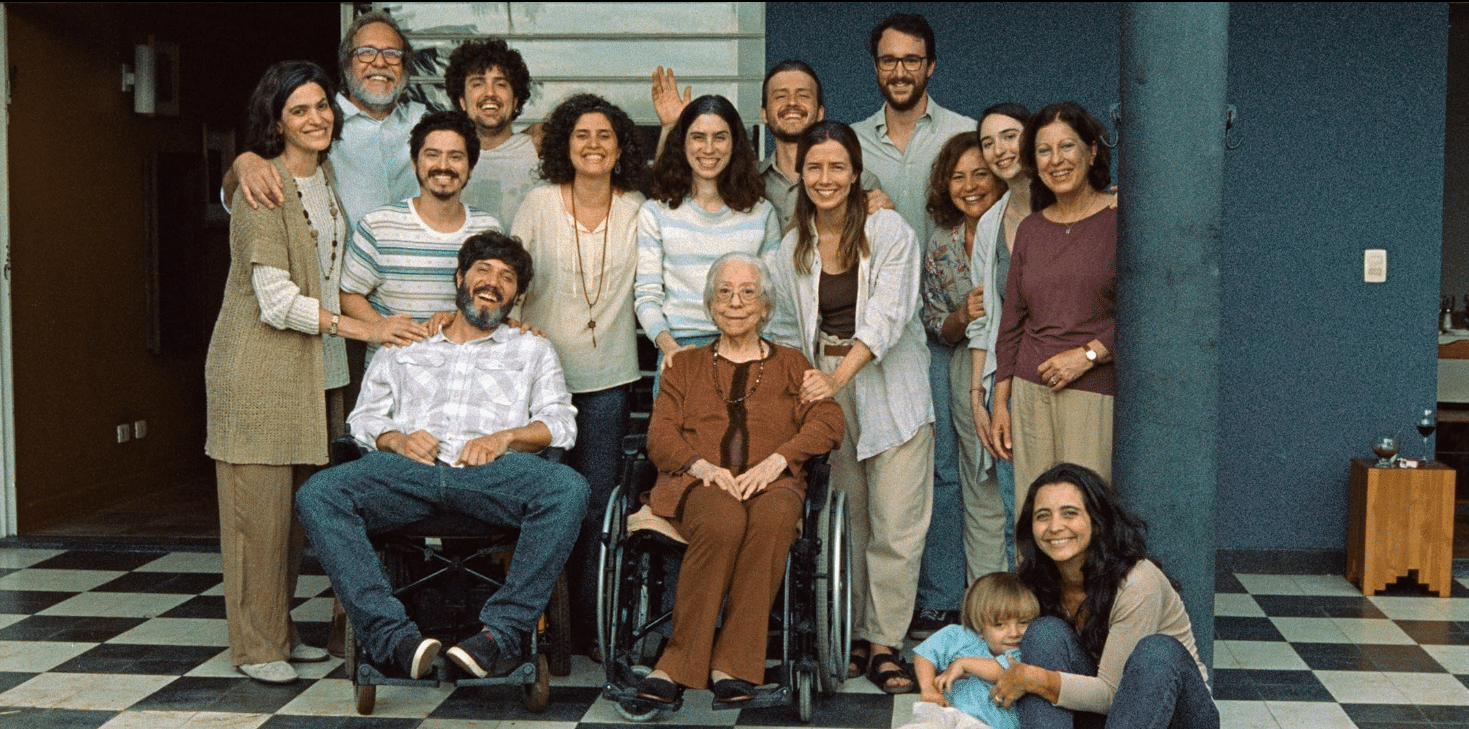
We jump ahead again to 2014 where 85-year old Eunice (played by Fernanda Torres’ real-life mother, Fernanda Montenegro), suffering from advanced Alzheimer’s disease, sits in her wheelchair staring blankly at the TV while her large extended family talks and laughs outdoors.
When a news report about the National Truth Commission shows a photograph of Rubens, Eunice’s face registers a flicker of recognition, a combination of that old carried grief and the infinite sweetness of memory. And truly, even though the closing title cards list all of Eunice Paiva’s accomplishments, it is that face we ourselves will remember.