

Home › Beat Sheets › Everything Was Beautiful and Nothing Hurt Novel Beat Sheet Analysis
Everything Was Beautiful and Nothing Hurt Novel Beat Sheet Analysis

Marilyn Brant
Why we chose to do a Save the Cat!® beat sheet analysis of Everything Was Beautiful and Nothing Hurt
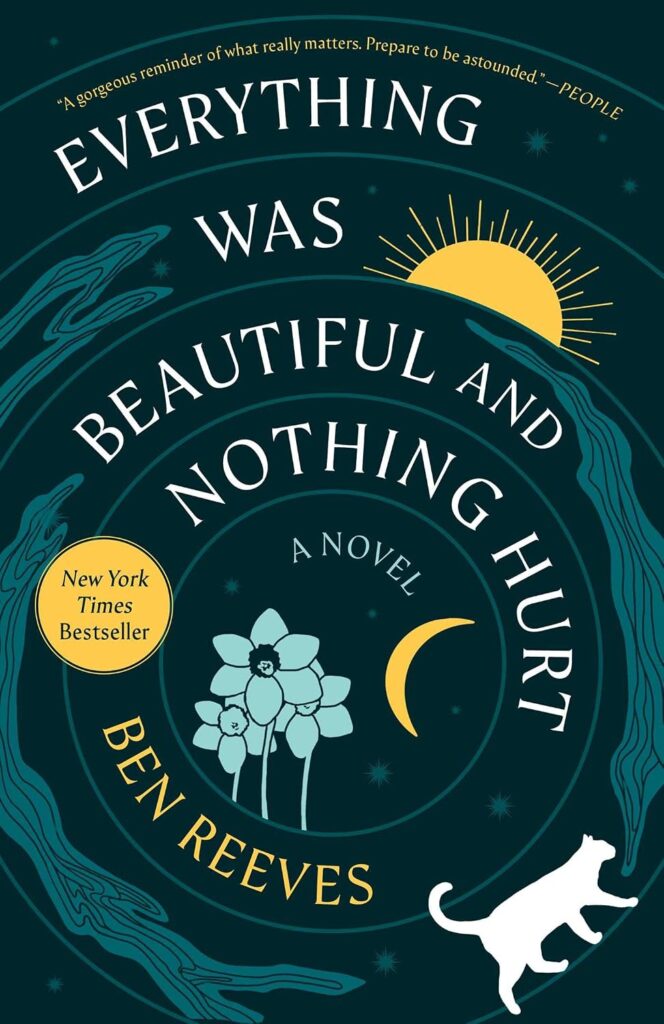
Everything Was Beautiful and Nothing Hurt by Ben Reeves is a literary fantasy narrated by Death, who comes to us in the form of a quiet, thirtysomething Englishman named Travis Smith.
With a title taken from a line in Kurt Vonnegut’s Slaughterhouse-Five, this powerful novel has been snowballing in popularity since its July 2026 release.
I was touched by the memorable characters, the thoughtful narrative structure, and the lyrical prose. I found it to be a unique and utterly unputdownable story.
Hope you’ll enjoy this beautiful debut novel as well!
Everything Was Beautiful and Nothing Hurt
Author: Ben Reeves
Publisher: Avid Reader Press/Simon & Schuster
Pages: 457 ebook (story pages 7-433)
Genre
Rites of Passage (plus a touch of Dude with a Problem)
A hero suffering through a relatable life problem (divorce, growing up, death, mid-life crisis, etc.) tries to solve it by avoidance instead of tackling it head-on. Like most heroes, they choose the wrong path and ultimately need to learn the hard way, for only the experience can offer a solution. The end point of these stories is acceptance of our humanity.
The 3 elements of a Rites of Passage story
1. A life problem: from puberty to midlife to death—these are the universal passages we all understand.
2. A wrong way to attack the mysterious problem, usually a diversion from confronting the pain.
3. A solution that involves acceptance of a hard truth the hero has been fighting, and the knowledge it’s the hero that must change, not the world around them.
From the Publisher
NEW YORK TIMES BESTSELLER
“A gorgeous reminder of what really matters. Prepare to be astounded.” – People
“One of the best, most moving books I have read in years.” – Scott Detrow, NPR
“This is one of the most affecting, original, and unforgettable novels I have ever read.” – Sarah Damoff, author of The Bright Years
For fans of Fredrik Backman and Virginia Evans, an astonishing novel about finding beauty in the brevity of life, as narrated by the one who knows it best: Death.
Travis is Death in the modern world. He lives with his cat in a small, gray town. His job is to offer people comfort in their final hours of life, which he does without complaint or judgement. He’s stoic, gentle, and a little naive, despite who he is, but he never tries to change anyone’s fate. He is responsible for maintaining the balance of nature, and every life must eventually end.
Then Travis meets Dalia, a midwife, and her boisterous eight-year-old daughter Layla, who live across the hall, and despite his best attempts to keep his distance, he finds himself wholeheartedly embraced by other people for the first time. So it is with this seemingly unremarkable family that Travis begins to understand what it means to be truly alive—and what might be irrevocably lost in death.
Written with radiant warmth, wisdom, and compassion, Everything Was Beautiful and Nothing Hurt is a timeless and ultimately uplifting story about appreciating life, accepting its end, and finding our place in the universe—especially when it feels most impossible—that will resonate with anyone who has ever loved and lost or worried about time’s passing.
Save the Cat! Beat Sheet Analysis for Everything Was Beautiful and Nothing Hurt
Opening Image (pages 7-11)

A car tumbles repeatedly before crashing, killing Samuel, the 29-year-old drunk driver within. Just before the man dies, Travis Smith (aka Death) appears to him, having slowed time long enough to comfort him and allow the man to express his regrets.
The dying driver, as we’ll later learn, is Dalia’s older brother. And while Samuel is intensely sad in his last moments, Travis remains kind and reassuring, if somewhat detached. He has an obligation, and he’s dutiful in performing it.
Set-Up (pages 11-55)

We meet the quiet and rather nondescript Englishman, who appears to be in his mid-thirties. In his small flat, Travis restores old photographs, depicting the beauty of people living through their ordinary moments, when he’s not wandering about the countryside, reaping souls, that is.
It’s three years later, but Travis still thinks about Samuel, the man who died in the car crash. Despite his desire to remain emotionally distant in order to do his job, none of the dead ever truly leave his mind.
A white cat invades his private space, forcing him to ask the neighbors across the hall if they have any cat food on hand. This is how we’re introduced to single mother and professional midwife Dalia, along with her two daughters—baby Neda and smart, spirited grade-schooler Layla.
We also meet a collection of people Travis interacts with, often on their dying day or close to it. When they see him, they recognize him for who he is and the role he plays, even if most people on the street barely notice him.
There are vignettes peppered throughout the novel of individuals in their final moments. Some are, indeed, random, but others are surprisingly connected to the main story line. They include a baby, less than six months old, who hasn’t yet learned to be fearful. An abusive man who knows how evil he’s been. An old woman, desperate to finally die already. And more. So many more. Humans. Animals. Even insects.
All of them face their mortality.
Theme Stated (pages 36, 197 & more)

There are several strong and persistent themes that pop up—sometimes stated openly, other times merely hinted at—but they’re present in nearly every chapter:
- That life quickens as we age and its brevity is part of what makes it so precious.
- That we all should pay more attention to the people who are most important to us.
- That we need others in our lives to combat loneliness.
- That love and loss can, and do, coexist.
The author doesn’t specifically reference Our Town by Thornton Wilder, but I couldn’t get that play out of my head as I was reading this novel. Particularly Wilder’s character Emily, who dies in childbirth and wants only to go back and relive an ordinary, unimportant day. She painfully realizes that her family doesn’t slow down enough to appreciate each other or the simple beauty around them. In grief, she asks, “Do any human beings ever realize life while they live it?… every, every minute?”
Given the literary fiction leanings of author Ben Reeves, I would be surprised if he wasn’t familiar with this classic. Certainly, Reeves poses similar questions to Wilder’s through the multiple viewpoints of his characters, and I found those themes compelling throughout.
Catalyst (page 55)

Dalia’s eldest daughter, the young Layla, slips a hand-drawn invitation beneath his door, asking Travis to attend her 8th birthday party in their apartment across the hall.
Debate (pages 55-85)

Travis doesn’t know how to handle this. He stares at the invitation for over an hour but feels it isn’t right for him to actively participate in the lives of his neighbors.
He is, after all, Death. He’ll never be capable of experiencing the feelings of a human. Although he carefully observes life, he doesn’t feel comfortable jumping in and taking part.
But Layla is persistent. He turns her down, tries to distance himself from them, and pointedly doesn’t attend the small birthday gathering. Nevertheless, he somehow finds himself drawn into their little family.
Break into Two (pages 85-88)

In engaging conversationally, first with Dalia and later with the kids, Travis crosses a kind of humanity threshold, entering an upside-down world of friendship, attachment, and community, which comes with mortal experiences he’s never personally encountered.
B Story (page 88)

More than a straightforward love story with a woman and her children, being with Dalia, Layla, and Neda allows Travis to truly feel the emotions of love, belonging, and even grief for the first time. Until now, these are feelings he’d only observed in others.
He soon becomes aware of how his and Dalia’s roles in the world contrast dramatically, i.e., as a midwife, she brings in new humans daily, while he ushers people out of this life.
Travis had always exhibited a sense of compassion for the dying, but he genuinely cares about Dalia, Layla, and Neda. He wants them to be happy. And, even more surprisingly, he wants to be happy with them.
Fun and Games (pages 94-174)

Travis has meals with Dalia and her girls and goes on outings with them. Layla visits him in his flat a few times each week, getting away from her baby sister, doing her homework in the corner, and worming her way into his heart with her quirky conversation and her interesting collection of snapshots.
Travis helps Layla bury her dead hamster. He meets some of their extended family members, like Layla’s and Neda’s respective fathers. And he continues to be present for those end-of-life moments when various people pass from their human life to whatever their afterlife may be.
He overwhelmingly witnesses these interactions with calmness and generally without judgment, but there’s a burgeoning sense of something inside of him changing.
For me, these scenes were reminiscent of the film Meet Joe Black (1998) when Brad Pitt’s character, who plays Death in the movie, experiences a range of human delights (such as the distinctive taste of peanut butter), while also reaping souls whenever necessary. Similar to the film, Travis is not only Death personified, but he’s portrayed as an immortal entity who—despite his powerful and omniscient nature—has something to learn from his closer connection to specific humans.
Midpoint (pages 174-186)

As he and Dalia both help Layla get dressed for her big “Halloween School Disco” event, Travis couldn’t be more fully integrated into their family life. He loves being a part of their warm, welcoming, little group. He’s charmed by Layla’s excitement and the thrill she feels wearing her costume and her scary zombie makeup. He’s touched that he belongs with them and is included in her preparations for the party. He also knows this joy won’t last, but he actively pushes that knowledge aside. Dalia even kisses him.
All outward indications are that this will be a fun and exciting night for everyone. A false victory for sure.
Got stuck with your story?
Save the Cat!® Story Suite software brings the method and your story work into one clear, organized workspace.

Bad Guys Close In (pages 187-225)

However, it’s the beginning of the end.
Not only does Layla come home early from the party because she’s feeling sick, but her illness gets increasingly worse. The makeup she’d worn for the disco did not get washed off when she returned home, so it camouflaged the serious rash developing on her skin.
When Dalia finally realizes the severity of Layla’s condition, she rushes her daughter to the hospital… but not soon enough. Layla is diagnosed with meningitis, and her health is rapidly declining.
Dalia is devastated, of course, but so is Travis. Until this point, he’s always managed to maintain a professional sense of detachment as Death. But now, his personal affection for all involved begins to crush him.
All Is Lost (pages 225-230)

Layla dies and Travis can’t stop the tragedy from happening. His first attempt to combat his prior loneliness and experience a human type of happiness has only resulted in heartbreak and grief.
Dark Night of the Soul (pages 231-247)

Not only is his grief profound, but so is his sense of guilt for his “role” in Layla’s passing. Travis is also aware that Dalia feels both guilt and grief even more strongly than he does, albeit for different reasons. Strongly enough that these potent and painful feelings might lead to her death, too. Possibly sooner, rather than later.
Break into Three (pages 247-249)

Layla’s funeral. Dalia is, understandably, numb. The grief of having lost her daughter truly sinking in. She eventually walks away, leaving the rest of them to the ceremony.
Finale (pages 249-432)

Travis tries to reach her. To help. To wallow in their shared grief. To assist her in cleaning Layla’s room.
A month after the funeral, Dalia packs up everything in their apartment and moves away. She can no longer live in a place with so many memories of Layla. She wants to kill herself and seriously tries, more than once.
But Travis is there. He realizes that trying to isolate himself from the pain denies the nature of love. He resolves to remain present, and he silently stands by Dalia through the agonizing days, months, and years that follow, even when she pushes him away. He offers quiet comfort as she slowly heals (to the extent that she can) and learns to live alongside her loss.
His love for her is steadfast, but it’s also special. In spite of himself, Travis admits that Dalia means more to him than the other humans he’s encountered. He wants her to live longer, even if it’s selfish of him to desire that, because he wishes for her to have a happier, more fitting end to her life. So, during her most serious suicide attempt, he breaks from his typical, cool detachment and pleads with her to please, please not kill herself.
The story fast-forwards through time. Decades later, Dalia reaches old age having lived a full, meaningful life despite her tragedy. When her time to die finally comes on her 90th birthday, Travis is there to escort her. Her family has just surprised her with a celebration she doesn’t initially want, but then she meets her first great-grandchild! Neda’s daughter has just had a baby of her own. A little girl they’ve named Layla.
Travis, now with a different face and different name—although Dalia still recognizes him—gives her a photo album of her life, many of the photos taken by her late daughter. Travis and Dalia look through the pictures, talk, laugh, feel the full weight of both the painful and the happier memories. And they dance one last time, even without music.
She tells him she wishes she could have just 20 minutes with her young girls again. She also tells him not to be lonely going forward. To embrace the living. Then she kisses him on the cheek, thanking him for making her wait until now to die naturally. Travis is still Death, but his love for Dalia and her daughters has transformed him. He’ll always carry with him the warmth of their love.
There’s a running vignette throughout the book about mayflies that are born, gain their wings, and dance for a single day before dying… highlighting the brief, intense, joyful, and beautiful nature of life before it ends. It’s a perfect complement to the human story.
Final Image (page 433)

Travis asks readers on the very last page what we’d do with the gift of 20 minutes at the end of our lives. He urges all of us to do it now.
NOW TRY IT ON YOUR STORY
Apply the same structure you just read to your own script or novel. Start mapping your beats for free.
Share this article:





Similar Articles








Subscribe to Save the Cat! Newsletter