

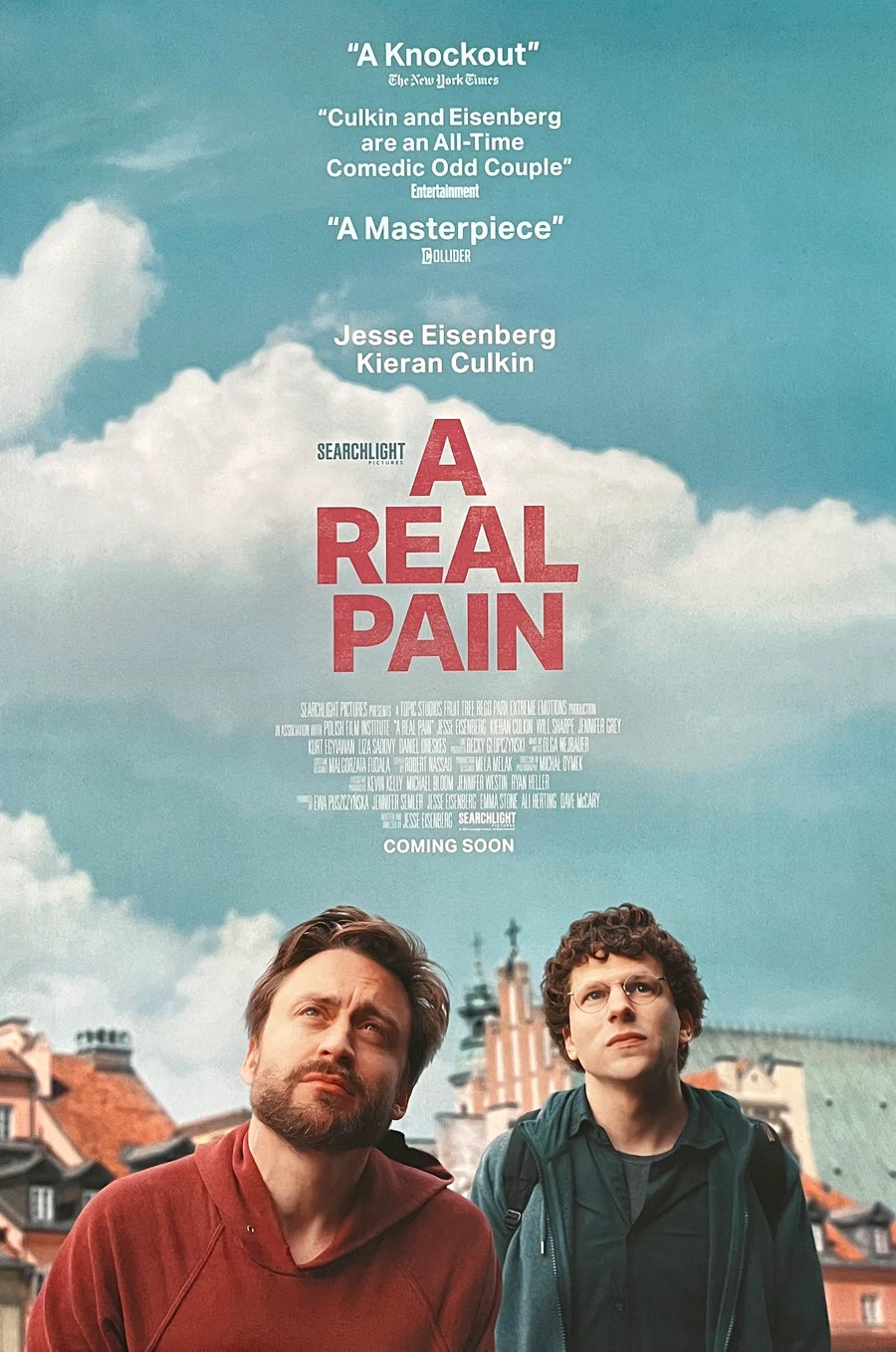
A Real Pain Beat Sheet Analysis
Why We Chose to Do a Save a Cat! Beat Sheet Analysis of A Real Pain
To this date, A Real Pain has garnered 85 nominations and 42 wins… and the Oscar® nominations haven’t even been announced yet! Among its wins are Kieran Culkin’s Golden Globe for
At Save the Cat!, we’re most interested in the screenplay—and Jesse Eisenberg’s script has already won the Waldo Salt Screenwriting Award at the Sundance Film Festival, Best Screenplay
A Real Pain is also one of the 10 Movies of the Year from the American Film Institute.
A Real Pain
Written and Directed by: Jesse Eisenberg
Genre: Golden Fleece – Buddy Fleece

The 3 elements of a GOLDEN FLEECE story are:
1) A road spanning oceans, time—or across the street—so long as it demarcates growth. It often includes a “Road Apple” that stops the trip cold.
2) A team or a buddy the hero needs to be guided along the way. Usually, it’s those who represent the things the hero doesn’t have: skill, experience, or attitude.
3) A prize that’s sought and is something primal: going home, securing a treasure, or re-gaining a birthright.
Golden Fleece – Buddy Fleece Cousins: Little Miss Sunshine; Y Tu Mamá También; Motorcycle Diaries; L’Aventura; On the Road; Easy Rider; Stranger Than Paradise; Thelma & Louise; Finding Nemo; National Lampoon’s Vacation; One Piece Pilot (TV); Planes, Trains and Automobiles
Save the Cat! Beat Sheet Analysis for A Real Pain
Opening Image
With Polish virtuoso Frédéric Chopin’s “Nocturne No. 2 in E-Flat Major, Op. 9, No. 2” playing in the background, the camera tracks slowly through an airport terminal, passing by scores of people on their way somewhere and circles back, almost as an afterthought, to Benji Kaplan (an astonishingly good Kieran Culkin).
His expression is unreadable, possibly a mixture of boredom, sadness, flashes of curiosity, and being a bit baked. The title card “A Real Pain” appears right next to Benji’s face, slyly conveying a multitude of meanings: in this film, we’re going to witness some deep suffering; truth has caused these wounds; and Benji can be a real pain in the ass.
Set-Up
Benji and David (Jesse Eisenberg) are American Jewish cousins about to embark on a physical and spiritual journey to Poland to visit their recently deceased grandmother’s childhood home and attempt to connect with their heritage. Our introduction to these two wildly different characters is quick and amusing; all it takes is a series of panicky phone calls from the tightly-wound David and an offer of a warm yogurt, sans spoon, from Benji’s grody pocket, and we know we’re in a “Buddy Fleece” thesis world with a whole lot of things that need fixing.
David and Benji were as close as brothers when they were young, but now there seems to be a considerable amount of strain in the relationship, partly due to their current mismatched lives (David has a corporate position, a family, and highly-medicated OCD; Benji is a pot-smoking jobless drifter who sleeps on his mother’s couch) and some past circumstances that will remain a mystery for the time being.
Theme Stated
In the hotel room, Benji admires David’s feet, which weirds David out a bit, but Benji says they remind him of Grandma Dory’s. “Sometimes, I look at you… and I see her.” The quest for identity, remembrance, relationship, and a proper honoring of both a people’s and an ancestor’s difficult journey will permeate every bit of this film—the deeply painful and the laugh-out-loud moments.
Catalyst
The cousins possibly could have skated through this vacay with tongues held and tempers at a low simmer, but the first part of their trip is with a tour group; once they meet their team with all of the requisite limps and eyepatches, much will be exposed and David and Benji will begin to see each other anew through these people’s eyes.
Debate
David watches with frustration and admiration as Benji charms everyone in the tour group with his emotional openness and keen observations. He immediately connects with each of them, especially Marcia (a lovely and understated Jennifer Grey), but David can’t help but cringe, knowing there’s a dark side to Benji’s charm and it’s only a matter of time before it comes out. Still, at times we see the naked yearning on David’s face, wishing he could effortlessly light up a room the way Benji does.

When the group visits the Warsaw Uprising Monument, Benji manages to not only get everyone, including the staid tour guide James (Will Sharpe), involved in a hilariously dramatic tableau, but somehow make David look like he has a major stick up his ass as he is left alone to take photos of the frivolity with five different phones. By the end of Day 1 of the tour, David is nearly at the end of his rope. That is, until…
Break into Two
That night in their hotel room, Benji thanks David profusely and genuinely for coming on the trip with him. Of course, this melts David’s heart and…
Fun & Games
It’s time to celebrate their bond by getting high! They embark on an adventure just like when they were young, Benji busting through an emergency door and pulling David up to the hotel roof to smoke a huge joint. But in this tricky antithesis world of cousin connection, there will be as many ups and downs as the various moods that Benji seems to cycle through in a single hour.
On the train to Lublin the next day, Benji lashes out in anger that they are Jews riding in first class and dishonoring their Polish ancestors, startling the rest of the tour group. After David hunts Benji down in the coach car, he falls asleep and they miss their stop. David is aghast and furious that Benji didn’t wake him up, but Benji said he couldn’t do it because it was like the old days when “I used to have you all to myself.”
How can you stay mad at this guy?! Especially when he immediately drags David into another adventure as they hop a train going back the other way and Benji manages to to evade the conductor and the ticket purchase, David giggling all the while.
Lest we think that the cousins are coming to some sort of true kinship, Benji soon chides David publicly for being emotionally closed off. “We’re on a fucking Holocaust tour, man, if now’s not the time to grieve and open up, I don’t know what to tell you.”
B Story
There’s a myriad of B Stories going on with the tour group team, but Grandma Dory, although not physically present, is the strongest B Story relationship for both cousins. Her ghost and the ghosts of her birthplace are as real and interactive as the living tourists David and Benji walk with through this experience.

Midpoint
In a false victory of symbolic remembrance, in the Old Jewish Cemetery the group places stones on the matzevah (monument) of Talmudist Jakub Kopelman, the oldest grave in Poland. This tradition signifies “you are not forgotten” and foreshadows our film’s much more nuanced finale.
Bad Guys Close In
At dinner that night with the tour group, Benji is in a foul mood and the cousins go at each other for the first time. Benji passive-aggressively states that Grandma Dory was the only one in the whole family who didn’t disappear when he needed them the most, and David counters by quoting their grandma’s gibe that immigrants’ second-generation descendants usually end up living in their parents’ basement and smoking pot all day.
Benji is deeply hurt, but he covers it with a rude departure, giving David the opportunity to finally “open up and grieve.” Fighting back tears, David tells the others that he is completely baffled by how Benji could be the product of all those who suffered through the Holocaust and struggled to survive as displaced persons in America, especially since Benji recently attempted suicide.
The dark secret is out and on the last day of the tour, David and Benji are barely speaking to each other. But their visit to the Majdanek concentration camp, a sequence shot with very few words and searing images of the showers, ovens, and thousands of shoes from those murdered there, brings the cousins (marginally) back together in their shared grief.
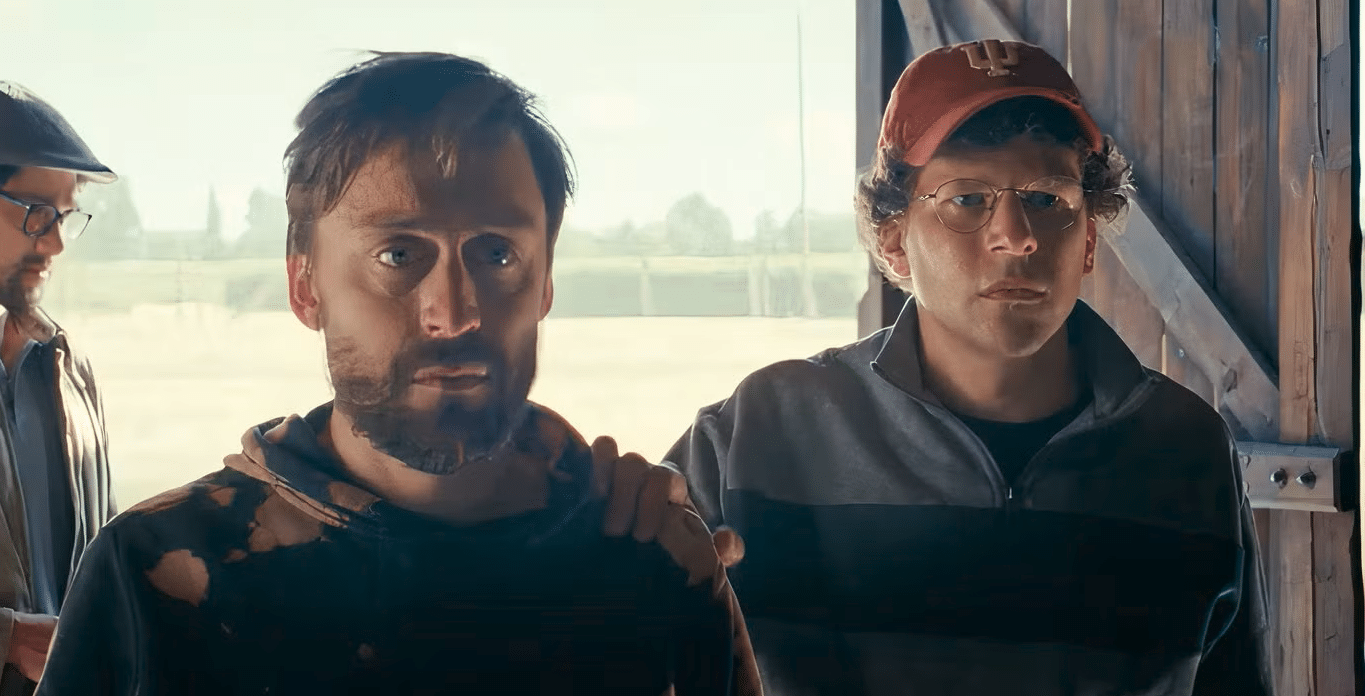
Immediately afterwards, the tour is over, their friends and buffers leave, and Benji and David are on their own again, struggling to connect.
All Is Lost
Benji and David get high again on the roof of a hotel, but there is no joy this time.
Dark Night of the Soul
David breaks down and cries, asking how Benji could have tried to kill himself, how he could think of throwing away his beautiful and brilliant life, the life that was given to him by a “series of tiny miracles.” Benji weeps, smokes his blunt, and can’t bring himself to answer. The cousins are at an impasse.
Break into Three
A sequence of silent scenes as David and Benji return sadly to their room and escape into sleep.
Finale
The next morning, Benji and David doggedly gather the team and execute the plan: to visit Grandma Dory’s childhood home in Kraznystaw. In true indie film fashion, however, the primal prize that was sought is about as underwhelming as possible; Grandma Dory’s house is singularly unremarkable and the cousins stand there in somewhat amused confusion, wondering how to feel about it.
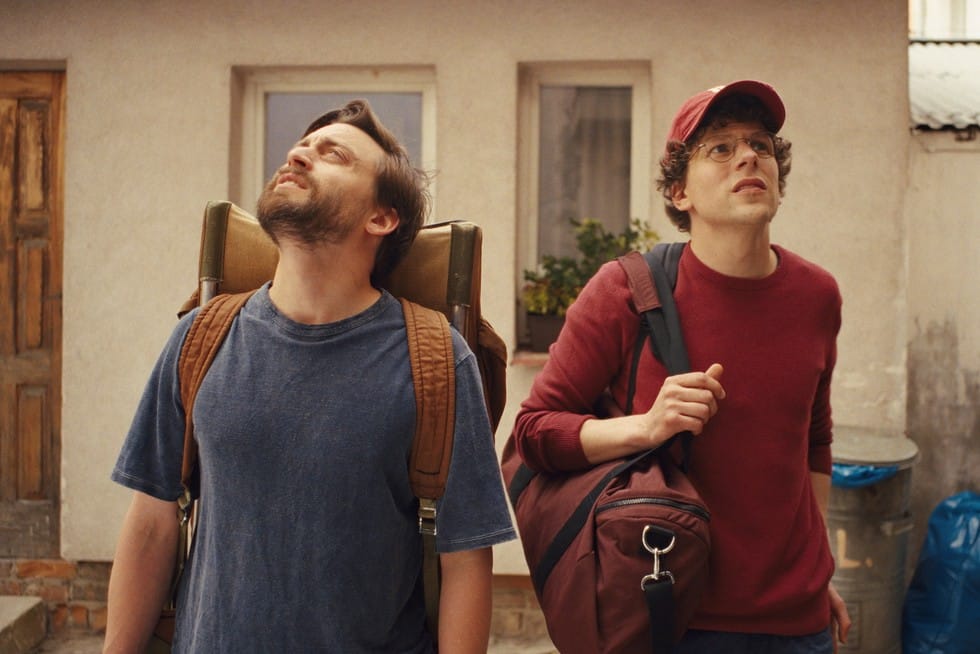
As they stare up at the mediocre culmination of their journey, Benji tells a story about how Grandma Dory slapped him once for showing up at her favorite restaurant late and drunk, saying that it gave him a sense of clarity he hasn’t experienced since. After their attempt to leave a stone of remembrance at the house is thwarted by a nosy neighbor, they head to the airport and fly back to New York.
Their time coming to an end, David makes one last-ditch effort, begging Benji to come to his home for dinner with his wife and child. When Benji says, nah, he’ll just hang out in the airport for a while, David digs down deep and gives us a truly shocking (and hilarious) high tower surprise, spontaneously slapping Benji across the face.
Benji is stunned and more than a little pissed, but the ridiculousness of David’s attempt to replicate Grandma Dory’s meaningful moment eventually makes the cousins laugh together and fall into a huge hug, achieving a very, very brief moment of synthesis. Benji assures David that he’s going to be fine; David doesn’t know if he believes him and neither do we, but one thing is certain: he’s not going to be able to save his cousin.
Final Image
David goes back to his home, leaving a rock of remembrance on the front stoop. As his loving family enthusiastically greets him, we cut to Benji at the airport, sitting in the same seat from the Opening Image.

Again, his expression is unreadable, but knowing the journey he’s just completed, we assume some emotions: sadness at circling back to the beginning without much closure; bewilderment at how in the world to truly honor the memory of those we’ve loved and lost; and, just before the screen goes black, the briefest of smiles, giving us a glimpse of the possibility of a brilliant and beautiful life, a life given by a series of tiny miracles.